
Blog Details
Published on 22 Jun, 2026 | Updated on 24 Jun, 2026 | By SmartNode ⏱️ 8 min read
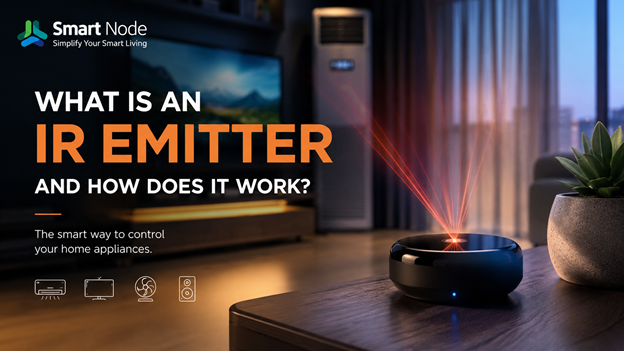
What Is an IR Emitter and How Does It Work?
Have you ever spent five minutes searching for your TV remote, only to find it stuck between the sofa cushions? Or maybe you’ve been comfortably tucked into bed when you realized the AC temperature needed adjustment. Instead of getting up, you reached for the remote and fixed it instantly.
We do these things almost every day without thinking about the technology behind them. But every time your TV changes channels or your AC responds to a button press, a small component called an IR emitter is working behind the scenes.
Most people have never heard of an IR emitter, yet it’s one of the most widely used technologies in our homes. From televisions and air conditioners to home theatres and projectors, infrared communication has been making our lives easier for decades.
Let’s understand what an IR emitter is, how it works, and why it remains an important part of modern smart homes.
What Is an IR Emitter?
An IR emitter (Infrared Emitter) is a small electronic component that sends infrared signals to compatible devices.
Think of it as a messenger.
Whenever you press a button on a remote control, the IR emitter sends a coded infrared signal to the device. The device receives that signal, understands the command, and performs the action.
For example:
- Press the Power button → TV turns on.
- Press Volume Up → Sound increases.
- Press Temperature Down → AC becomes cooler.
- Press Mute → Audio stops instantly.
The entire process happens in less than a second.
What’s interesting is that infrared light is invisible to the human eye. So even though communication is happening constantly, you never actually see it.
You Probably Use an IR Emitter Every Day
Let’s be honest.
Most of us never think about infrared technology until something stops working.
TV ka remote kho gaya ho toh pura ghar usse dhundhne lagta hai.
Suddenly, everyone becomes an expert at finding remotes.
That’s because remote controls have become such a normal part of our lives that we don’t notice them anymore.
The reason those remotes work is simple: they contain an IR emitter.
Every button you press sends a unique infrared signal to the device you’re controlling.
Technology is at its best when it quietly does its job without demanding attention. IR emitters are a perfect example of that.
A Real-Life Example Everyone Can Relate To
Picture this.
It’s 11:30 PM.
You’ve finally finished a long day and settled into bed.
The lights are off. You’re comfortable. Sleep is almost here.
Then suddenly…
The room feels a little cold.
The AC temperature is set too low.
Now begins the search.
Remote kaha gaya?
Under the pillow?
On the side table?
Inside the blanket?
We’ve all experienced this at least once.
When you finally find the remote and press the temperature button, the IR emitter inside the remote sends a command to the AC. Within seconds, the temperature adjusts.
It’s a simple interaction, but one we rely on every day.
How Does an IR Emitter Work?
The technology behind an IR emitter is surprisingly simple.
Step 1: A Command Is Created
Everything starts when a user performs an action.
This could be:
- Pressing a remote button
- Using a mobile app
- Activating a smart home scene
- Giving a voice command
For example:
“Turn on the TV.”
Step 2: The Command Is Converted into a Signal
Every function has its own unique code.
The system converts your command into an infrared signal that the target device can understand.
Step 3: The IR Emitter Sends the Signal
The IR emitter flashes infrared light pulses containing the command.
These pulses travel toward the receiving device.
Step 4: The Device Receives the Signal
An infrared receiver inside the device captures the signal and decodes it.
Step 5: The Action Happens
The device performs the requested task.
Whether it’s turning on a TV, lowering the AC temperature, or changing a channel, the entire process happens almost instantly.
Why IR Emitters Still Matter Today
Many people assume modern devices only use Wi-Fi or Bluetooth.
But that’s not entirely true.
Millions of devices still depend on infrared communication, including:
- Televisions
- Air conditioners
- Set-top boxes
- Home theatre systems
- Projectors
- Audio systems
Replacing all these devices just to make them smart would be expensive and unnecessary.
That’s where IR emitters become valuable.
Instead of replacing your existing appliances, they allow them to become part of a smart home ecosystem.
IR Emitters in Smart Home Automation
Imagine walking into your home after work.
You tap a single button called “Welcome Home.”
Immediately:
- Lights turn on.
- AC starts automatically.
- Curtains open.
- TV powers on.
The experience feels effortless.
What many homeowners don’t realize is that IR emitters often play a key role in making these automations possible.
Rather than using multiple remotes, a smart automation system sends infrared commands on your behalf.
No confusion.
No juggling remotes.
No opening multiple apps.
Because nobody buys a smart home to manage five different controls.
A smart home should simplify life, not complicate it.
Benefits of Using an IR Emitter
1. Cost-Effective Solution
You don’t need to replace existing appliances.
Your current TV, AC, or home theatre can still become part of a smart home.
2. Reliable Performance
Infrared technology has been trusted for decades because it works consistently.
3. Easy Integration
IR emitters can communicate with a wide range of electronic devices.
4. Better User Experience
Controlling everything from one app is far more convenient than managing multiple remotes.
5. Improved Home Automation
IR emitters help bridge the gap between traditional appliances and modern smart technology.
IR Emitter vs IR Receiver
People often confuse these two terms.
Here’s the simple difference:
| IR Emitter | IR Receiver |
|---|---|
| Sends signals | Receives signals |
| Found in remotes and automation systems | Found inside TVs, ACs, and other devices |
| Acts as the sender | Acts as the listener |
Both components work together to complete communication.
Without an IR emitter, there would be no signal.
Without an IR receiver, there would be no response.
The Future of IR Emitters
Even as technologies like Wi-Fi, Bluetooth, and Zigbee continue to grow, infrared communication remains highly relevant.
Why?
Because millions of homes already own devices that rely on infrared control.
IR emitters allow homeowners to connect those devices to modern automation systems without replacing them.
It’s practical.
It’s reliable.
And most importantly, it works.
That’s why infrared technology continues to be an important part of smart home automation even today.
Conclusion
An IR emitter may be small, but its impact is huge.
From changing TV channels and adjusting air conditioners to integrating traditional appliances into modern smart homes, IR emitters quietly make everyday life more convenient.
Most people never notice them working.
And that’s exactly the point.
The best technology isn’t the technology you constantly think about.
It’s the technology that simply works.
Whether you’re using a TV remote or controlling your entire home through a Smart Node automation system, chances are an IR emitter is helping make it happen.
FAQs About Smart Home Devices
An IR emitter is used to send infrared signals to electronic devices such as TVs, air conditioners, projectors, and home theatre systems.
Yes. In most cases, an IR emitter works best when it has a direct or near-direct path to the device’s infrared receiver.
Absolutely. Most air conditioners use infrared communication, allowing IR emitters to send commands such as temperature adjustment, mode selection, and power control.
Yes. Many smart home automation systems use IR emitters to control existing appliances that rely on remote controls.
An IR emitter typically controls one device or a small group of devices, while an IR blaster sends stronger infrared signals that can control multiple devices across a larger area.
Yes. Using IR emitters, existing TVs, air conditioners, and entertainment systems can often be integrated into modern smart home automation setups without replacing the appliances.
Related Blogs
24 Jun, 2026
Blog
Automatic Curtain Opener: How It Works & Why You Need One
Most people don't think much about their curtains.They open them in the morning,…
23 Jun, 2026
Blog
Smart IR Blaster vs Traditional Remote: What’s the Difference?
What Is an IR Blaster and Why Do You Need One?It's 9 PM.…
21 May, 2026
Blog
Door Access Control: The Complete Guide to Smart and Automatic Lock Systems
There was a time when locking a door felt simple. Turn the key,…