Published on 21 May, 2026 | Updated on 28 Jul, 2026 | By SmartNode ⏱️ 8 min read
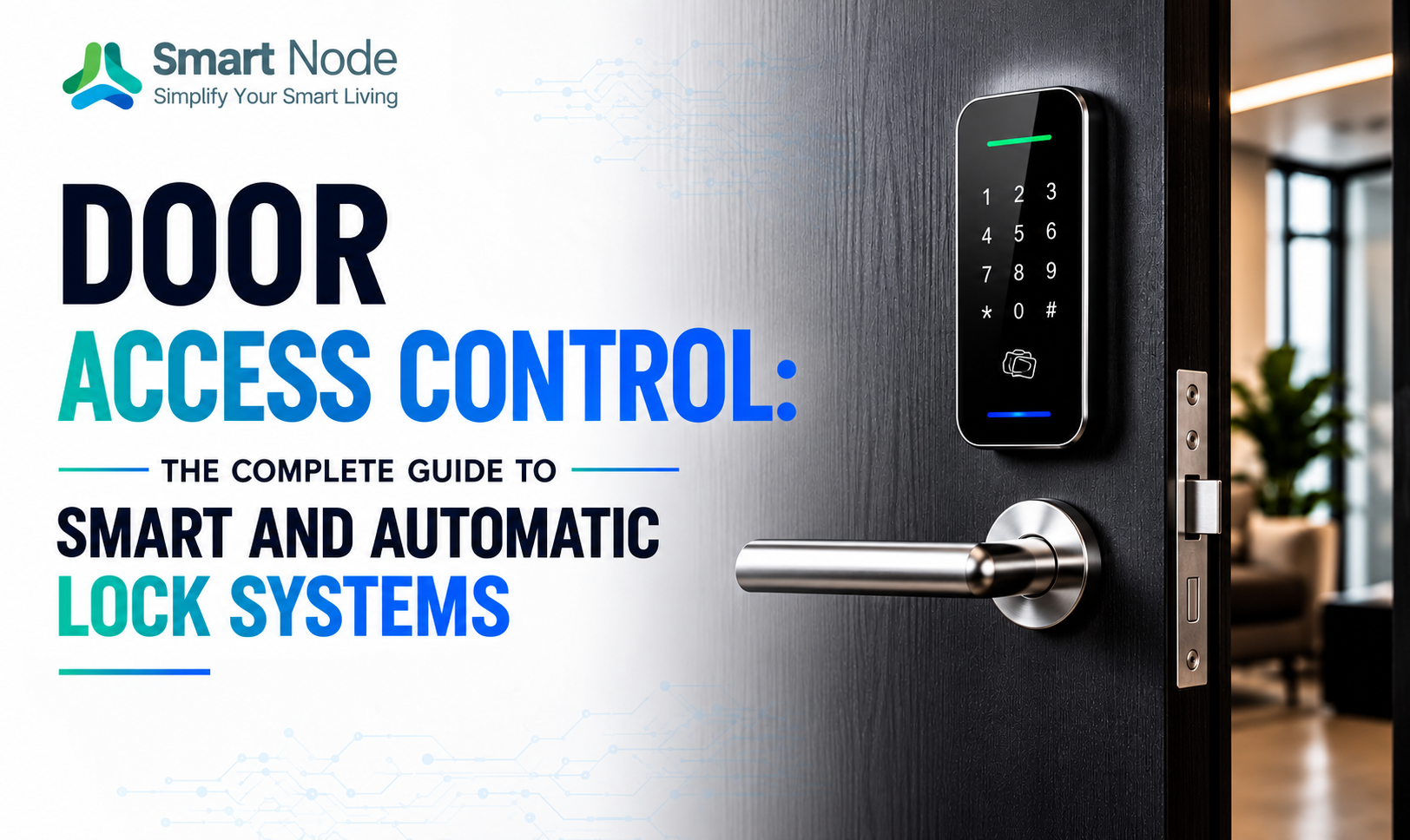
Door Access Control: The Complete Guide to Smart and Automatic Lock Systems
There was a time when locking a door felt simple. Turn the key, pull the handle once to double-check, and walk away.
That routine worked for years. In fact, most people never questioned it. A single key, one entry door, and a predictable daily schedule made security feel manageable.
But homes today do not function the way they used to.
A typical household now has multiple people moving in and out at different times. Children leave early for school. Parents return late from work. Helpers arrive in the morning. Deliveries show up unexpectedly. Guests come without notice.
Some homes have more than one entry. A main door, a service entry, terrace access, sometimes even a separate office room inside the house.
Managing all of this with physical keys slowly turns into a daily inconvenience. Someone forgets a key. Someone loses one. Someone makes a duplicate without informing others.
That is where door access control stops being a luxury and starts becoming a necessity.
It is not about replacing locks just to look modern. It is about making daily access simpler, safer, and easier to manage without constant worry.
From Traditional door locks to Smart door lock systems, the shift is already happening in homes, offices, and commercial spaces that want better control without adding complexity.
What Is Door Access Control?
At its simplest, door access control is about deciding who can enter a space and when they are allowed inside. Instead of depending only on physical keys, access is managed digitally using PIN codes, fingerprint recognition, RFID cards, or a mobile application.
But the real value of door access control becomes clearer when you look at everyday life.
Take a typical premium apartment setup. In many homes, domestic staff arrive during fixed hours each morning. Drivers may need access to parking areas. Delivery personnel might arrive when nobody is home.
Without access control, managing this becomes repetitive. Keys have to be handed over. Sometimes they are forgotten. Sometimes they remain with people longer than expected.
With door access control, entry can be scheduled for specific time windows. For example, staff can be allowed access only between 9 in the morning and 11 in the morning. Outside that time, the door remains locked automatically.
No reminders. No follow-ups. No uncertainty.
At its core, door access control replaces uncertainty with control. It allows homeowners and businesses to define permissions, monitor activity, and maintain security without creating daily friction.
And once people experience that control, going back to traditional keys feels unnecessarily complicated.
Why Traditional Locks Are No Longer Enough
Traditional locks still exist everywhere. They are familiar. They are widely trusted. But familiarity does not always mean reliability.
As homes and workplaces grow more dynamic, traditional locks reveal limitations that many people only notice after facing a problem.
Physical Key Vulnerabilities
Most people do not think about keys until one goes missing.
It usually begins with a small incident. Someone forgets their key at work. A spare key is shared with a relative. Another copy is made for convenience.
Over time, tracking those copies becomes difficult.
In rental properties, this becomes even more serious. Keys pass between tenants, maintenance staff, and sometimes agents. Eventually, homeowners reach a point where they are unsure who still has access.
Many end up replacing locks not because something happened, but because they feel uncertain.
That uncertainty itself becomes the real risk.
Digital access control changes this completely. Permissions can be updated instantly. If access needs to be removed, it takes seconds. No physical replacement required.
That shift alone removes one of the biggest weaknesses of traditional locking systems.
No Audit Trail or Remote Control
With traditional locks, everything happens silently.
A door opens. A door closes. Nobody knows when or who accessed it.
This becomes challenging in offices where employees enter at different times. It also becomes difficult in homes where elderly family members stay alone during the day.
Modern access systems bring visibility into daily activity.
For example, parents working late often worry whether children reached home safely. With smart access control, they receive a notification the moment the door unlocks.
That simple confirmation removes unnecessary anxiety.
Remote control adds another layer of flexibility. If a guest arrives early, access can be granted without rushing back home.
Security becomes responsive instead of reactive.
Inability to Scale Across Multiple Entry Points
One door is easy to manage.
Three doors begin to feel complicated.
Five doors become frustrating.
Many modern homes include multiple access points without homeowners fully realizing it. A main entrance, terrace door, service area, and storage access are common in large residences.
Managing separate keys for each entry quickly becomes inefficient.
Door access control solves this problem quietly in the background. Permissions can be assigned to specific users for specific doors.
If expansion happens later, new entry points can be added without rebuilding the entire system.
That flexibility matters more than most people expect.
Types of Door Access Control Systems
Not every space requires the same level of control. The right system depends on how frequently a door is used and how many people interact with it.
Understanding the different types helps in selecting what fits daily usage patterns rather than simply choosing what looks advanced.
PIN Based Access Control
Keypad systems are often the first step people take when moving away from traditional keys.
Instead of carrying a physical key, users enter a PIN to unlock the door.
In family homes, this becomes especially useful for children. Instead of worrying about lost keys, they remember a simple code. If the code needs to change, it can be updated instantly.
There is no need to replace locks or distribute new keys.
That convenience makes keypad systems a practical starting point.
RFID Based Access Control
RFID systems are commonly seen in workplaces, hotels, and commercial buildings.
Employees simply tap their card to enter. The process takes seconds and keeps movement smooth.
One of the biggest advantages appears when a card is lost. Instead of replacing locks, administrators deactivate the card and issue a new one.
Operations continue without disruption.
For offices handling daily staff movement, this reliability becomes essential.
Biometric Access Control
Biometric systems rely on something personal rather than something physical.
Fingerprints are the most common method.
In premium homes, biometric access becomes valuable when users want fast entry without searching for keys or remembering codes.
Hands full with groceries. Carrying luggage. Holding a child.
In such moments, unlocking with a fingerprint feels natural rather than technical.
Security becomes effortless instead of complicated.
Smart Door Lock System
A smart door lock system changes how access feels in daily life.
Instead of relying on one method, it offers multiple options. Fingerprint, PIN, mobile app, sometimes even voice commands.
Imagine a situation where a guest arrives earlier than expected. Traditionally, this creates inconvenience. Someone must rush back or hide a spare key somewhere.
With a smart lock, access can be shared instantly through a mobile app.
The door opens without physical presence.
That flexibility turns security into convenience.
Automatic Lock System
One of the most common security gaps happens because of simple human habits.
People forget.
Doors remain unlocked not because of negligence, but because routines get busy.
In offices, especially, this happens frequently. One employee assumes that another locked the door. By the time someone realizes the mistake, hours may have passed.
An automatic door lock system removes that dependency on memory.
Once the door closes, it locks automatically.
No reminders. No need for double-checking.
Just consistent security working silently in the background.
Frequently Asked Questions About Door Access Control
Yes, most smart door lock systems are designed to continue working even during a power outage. They usually operate on internal batteries, so locking and unlocking remain functional. In many homes, users rarely notice power-related issues because the system keeps running independently until power returns.
Additionally, many modern smart locks now come with an emergency Type-C power backup feature. In case the internal battery is fully drained, users can simply connect a Type-C power bank to temporarily power the lock and unlock the door safely. This adds an extra layer of convenience and reliability during unexpected situations.
Yes, an automatic door lock system works very well in residential settings. It is especially helpful for families with busy routines, where doors may sometimes be left unlocked by mistake. Once the door closes, it locks automatically, which adds consistency and reduces the chances of human error.
Biometric door access control is considered highly secure because it relies on unique identifiers such as fingerprints. Unlike keys or PIN codes, fingerprints cannot be easily shared or duplicated. In daily use, this makes biometric systems reliable for homes, offices, and spaces that require controlled entry.
Related Blogs
09 Oct, 2026
Blog
Smart Remote Control Systems for Home Automation
A modern living room can have a surprising number of remotes. One for…
09 Oct, 2026
Blog
Smart Power & Socket Automation Guide
A socket is easy to ignore until you start thinking about everything connected…
09 Oct, 2026
Blog
Office Automation Systems: A Practical Guide to Building Smarter Workspaces
An office usually reveals how it is managed within the first few minutes.…