Published on 28 Jul, 2026 | Updated on 28 Jul, 2026 | By SmartNode ⏱️ 12 min read
Curtain Automation: How It Works and Why Every Indian Home Needs One
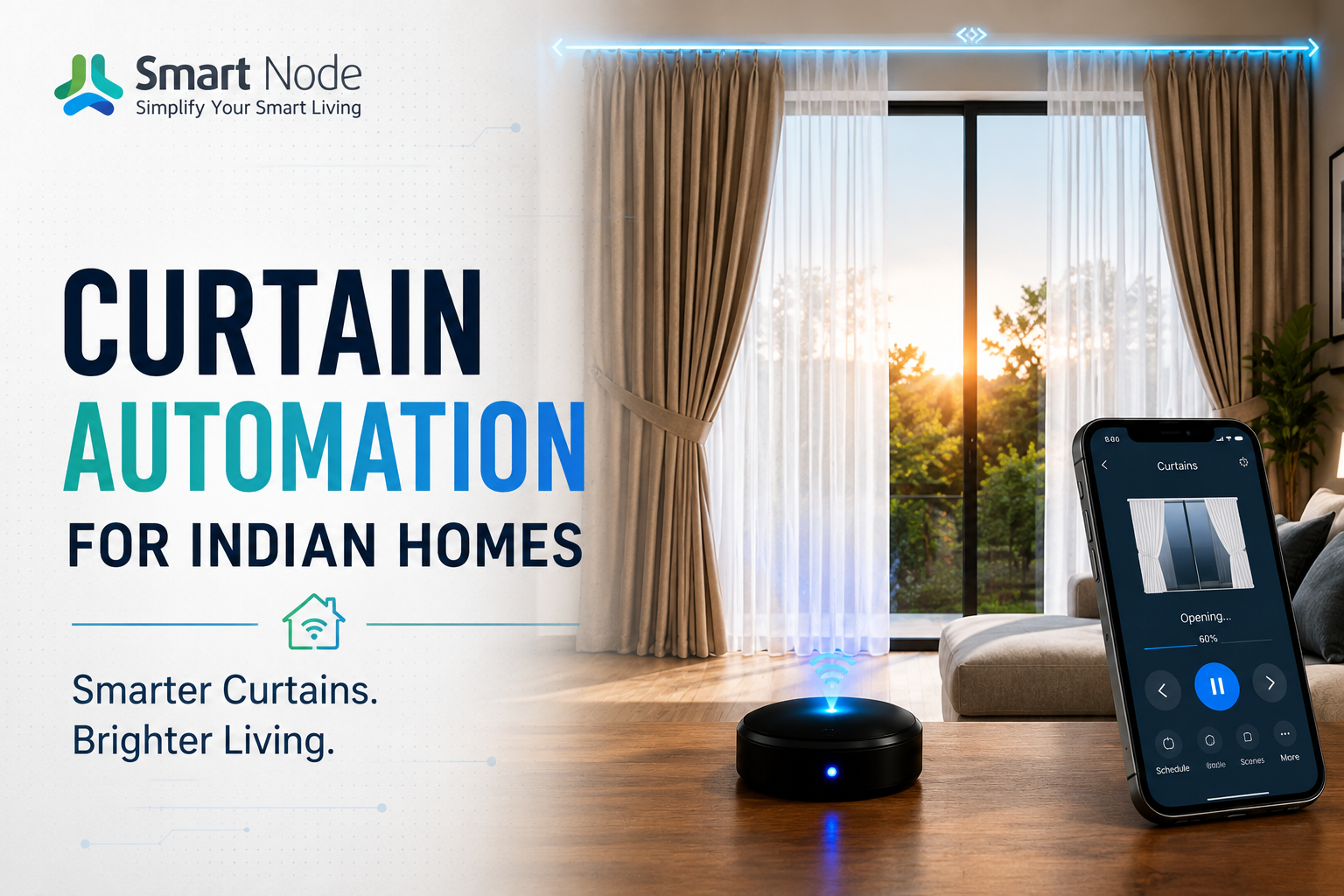
It’s 7 AM on a Saturday in Vadodara, and the sun is already pushing hard against the bedroom curtains. Ten years ago, someone would have had to get up, walk across the room, and pull them open by hand, half asleep, stubbing a toe on the bed frame along the way. In one home we heard about recently, the curtains just open themselves. Soft light fills the room a few minutes before the alarm goes off, gentle enough that nobody actually needs the alarm anymore.
That’s the entire idea behind curtain automation for Indian homes, minus the poetry. A motor does what your hand used to do, and it does it on a schedule, a voice command, or a tap on your phone.
The Core Components of a Curtain Automation System
A curtain opener automatic setup is simpler than most people expect. There are really only three parts working together.
The first is the motor itself, which attaches to your existing curtain track or comes with a new track designed for automation. This is the part doing the physical work of pulling the curtain open or closed.
The second is the controller or hub, which is what lets the motor talk to your phone, your voice assistant, or your other smart devices. Some motors connect directly over Wi-Fi without needing a separate hub at all, which is usually the simpler route for a single room.
The third is the app or interface, where you actually set schedules, create scenes, and control things when you’re not home. A good app should feel less like software and more like a light switch that happens to live on your phone.
For a working couple in Bangalore juggling early meetings and late traffic, this combination means the living room curtains close automatically at dusk, whether anyone remembers to do it or not. For a joint family in Surat with grandparents who like their afternoon nap in a dark room, it means the same curtain can follow two very different routines without anyone touching a remote.
Types of Curtain Automation Systems Available in India
Not every curtain automation system works the same way, and the differences matter more once you’re actually shopping.
Track-based motors sit inside a rail above the window and pull the curtain along the track, similar to how a manual track works but motorized. These suit most Indian window styles and are the most common option in villas and apartments alike.
Rod-mounted motors attach directly to an existing curtain rod, which makes them a favourite for retrofits where the homeowner doesn’t want to replace the entire window treatment.
Roller and zebra blind motors are a slightly different category, built for the roller-style blinds increasingly popular in home offices and study rooms across Ahmedabad and Pune. They roll fabric up rather than sliding it sideways, which changes the mechanics but not the convenience.
A senior citizen living alone might prefer a simple rod-mounted motor with one clear schedule and a single button on the wall, no app required. An architect designing a new villa from scratch, on the other hand, will usually build track-based motors into the plan from day one, hidden inside a false ceiling channel so the mechanism disappears completely.
How Curtain Automation Connects to Your Smart Home
Curtain automation rarely lives in isolation. Once it’s in place, it usually becomes one thread in a larger fabric of routines running through the house.
Wi-Fi, Zigbee, and Z-Wave: Which Connectivity Works Best in India?
Wi-Fi motors connect straight to your home router, which means no additional hub, but they can strain a weak router if you’re running many devices on the same network. Zigbee and Z-Wave motors need a central hub, but that hub often manages dozens of devices at once with better reliability and lower power draw, which matters in a country where Wi-Fi routers aren’t always rock solid.
For a large villa with fifteen or twenty automated points across curtains, lights, and locks, Zigbee tends to hold up better under load. For a single apartment room, Wi-Fi is usually simpler and cheaper to set up.
Works With Alexa, Google Home, and Siri: What to Confirm Before Buying
Most curtain motors sold in India today claim compatibility with Alexa or Google Home, but the real question is whether that compatibility survives an update six months later. Before buying, it’s worth checking whether the brand has an active presence on the Alexa and Google Home skill stores, because abandoned integrations are a common frustration.
Siri support through Apple HomeKit is rarer and worth confirming directly with the manufacturer if you’re an iPhone household, since not every motor on the market has been certified for it.
Creating Scenes and Routines: Curtains With Lights, AC, and Alarm
This is where curtain automation for Indian homes stops feeling like a gadget and starts feeling like part of the house. A “Good Morning” scene might open the curtains, switch on the coffee machine, and nudge the AC up two degrees, all triggered by one alarm going off. A “Movie Night” scene closes the curtains, dims the living room lights, and switches the TV to the right input, all at once.
Technology tab achhi lagti hai jab woh dikhai na de, sirf kaam kare. That’s really the whole philosophy behind scene-based automation. Nobody wants to think about five separate devices. They just want the room to feel right when they walk in.
Why You Need Curtain Automation: The Real Benefits for Indian Homes
Beyond the obvious convenience, there are a few reasons this has moved from luxury add-on to genuinely practical upgrade for Indian homes.
Energy savings show up quickly once curtains start closing automatically during the harshest afternoon sun, keeping rooms cooler and easing the load on the AC. In cities like Ahmedabad and Delhi where summer heat pushes indoors for months, that’s not a small thing.
Privacy and security improve too, since scheduled curtain movement makes an empty house look lived-in while the family is travelling. A villa left empty for a week during Diwali holidays, curtains opening and closing on schedule, looks nothing like an unattended home from the street.
Fabric protection matters for anyone who’s invested in good curtains, since scheduled closing during peak sun hours reduces fading over time, something most people only notice after the damage is already done.
And for families with young children or elderly parents, there’s a real safety angle. No dangling cords to worry about, no climbing on furniture to reach a stuck curtain rod.
Curtain Automation for Different Rooms in an Indian Home
The value of curtain automation for Indian homes changes depending on which room you’re talking about, and it’s worth thinking room by room rather than treating the whole house the same.
Bedroom: Sleep, Wake-Up, and Privacy Scheduling
A gradual light-based wake-up, curtains opening slowly fifteen minutes before the alarm, is one of the most requested features from parents trying to ease children into mornings without a jarring buzzer. At night, a single voice command closes every bedroom curtain in the house without anyone leaving their bed.
Living Room: Sunlight Control and Entertainment Scenes
This is usually the room with the biggest windows and the most foot traffic, which makes it the natural home for scene-based automation tied to movie nights, dinner parties, and lazy Sunday afternoons.
Home Office: Glare Reduction and Focus Scheduling
With remote work now a permanent fixture in many Indian households, glare on a laptop screen during a 3 PM video call is a genuine daily annoyance. Scheduled curtain adjustments through the workday solve this quietly, without anyone having to get up mid-meeting.
Kitchen and Dining: Natural Light Without the Manual Effort
Kitchens often have small, awkwardly placed windows above the sink or counter, exactly the kind that people stop bothering to adjust because reaching them means climbing over dishes. Automation removes that friction entirely.
What to Check Before Buying a Curtain Automation System in India
A few practical checks save a lot of regret later. Confirm the motor’s load capacity matches your curtain’s weight, especially for heavy blackout or velvet fabrics common in Indian bedrooms. Ask about battery life versus wired power, since battery motors are easier to retrofit but need charging every few months depending on usage. Check warranty and local service support, because a motor stuck at the top of a two-storey window is not something you want to troubleshoot yourself. And ask specifically whether the brand’s app has been updated recently, since an abandoned app is the fastest way for a good motor to become a useless one.
Installation Overview: Can You Do It Yourself or Do You Need Help?
DIY Retrofit Installation: What It Involves Step by Step
For a single rod-mounted motor, DIY installation usually involves removing the existing rod, fitting the motorized rail bracket, rehanging the curtain, and pairing the motor with the app, a process most comfortable DIYers finish in under an hour per window.
When Professional Installation Is the Better Choice
Villas with multiple rooms, hidden ceiling channels, or an integrated whole-home system are a different story. Professional installers handle wiring, hub placement, and scene programming in a way that’s genuinely hard to replicate solo, and it’s usually where working with a home automation company like Smart Node makes the difference between a set of gadgets and a system that actually works together.
Is Curtain Automation Suitable for Rented Homes in India?
Rod-mounted, battery-powered motors are the most rental-friendly option, since they require no drilling into existing tracks and can be removed entirely when the lease ends, curtains and all.
Common Mistakes People Make With Curtain Automation
The most common mistake is buying a motor before measuring the curtain’s actual weight, which leads to a motor straining or failing within months. A close second is ignoring Wi-Fi signal strength near the window, which causes maddening lag between command and action. And plenty of people skip reading how scenes and routines work altogether, missing out on the part of the system that actually makes daily life easier.
Future Trends in Curtain Automation
Motion and light sensors are starting to make their way into curtain systems, allowing curtains to respond to actual sunlight intensity rather than a fixed clock time. Voice assistant integration keeps getting faster and more reliable, and battery technology is stretching charging cycles from months to closer to a year, making retrofit installs even less maintenance-heavy than they already are.
A Smart Node Perspective
Ghar sirf deewaron se nahi banta, uski comfort uski asli pehchaan hoti hai. That comfort is really what curtain automation for Indian homes is about, not the motor or the app, but the feeling of a home that quietly takes care of the small things. Smart Node builds curtain automation as part of a wider home automation system, so curtains, lights, AC, and security work off the same app and the same scenes instead of living as separate gadgets that never quite talk to each other. For anyone planning a new villa or upgrading an existing home, that’s usually where the real difference shows up.
Conclusion
Curtain automation isn’t about chasing the newest gadget in the house. It’s about a hundred small daily moments, waking up to soft light instead of a blackout room, walking into a living room that’s already dimmed for movie night, coming home from a trip to curtains that never once gave away that the house was empty. If you’re planning a smarter, safer, and more comfortable home, Smart Node can help you build a home that works beautifully around your lifestyle.
FAQs: Curtain Automation for Indian Homes
Yes, in most cases. Rod-mounted and track-based motors are designed to work with your existing curtains, as long as the fabric’s weight is within the motor’s load capacity. You typically don’t need to replace the curtains themselves, only the rod or track mechanism they hang from.
Wired motors will pause until power returns, though most systems remember their last schedule and resume normally. Battery-powered motors keep working through outages since they don’t depend on mains electricity, which is one reason they’re popular in areas with frequent power fluctuations.
Extremely heavy fabrics like thick velvet or multi-layered blackout curtains sometimes exceed standard motor load limits, and pleated or accordion-style curtains need special motor types built for that folding action. Checking your curtain’s weight and style against the motor’s specifications before buying avoids this issue entirely.
Yes, as long as the system is connected to Wi-Fi and paired with its app, you can open, close, or schedule curtains from anywhere with an internet connection, which is exactly what makes vacation scheduling and remote security scenes possible.
Related Blogs
09 Oct, 2026
Blog
Smart Remote Control Systems for Home Automation
A modern living room can have a surprising number of remotes. One for…
09 Oct, 2026
Blog
Smart Power & Socket Automation Guide
A socket is easy to ignore until you start thinking about everything connected…
09 Oct, 2026
Blog
Office Automation Systems: A Practical Guide to Building Smarter Workspaces
An office usually reveals how it is managed within the first few minutes.…