Published on 26 Aug, 2026 | Updated on 26 Aug, 2026 | By SmartNode ⏱️ 11 min read
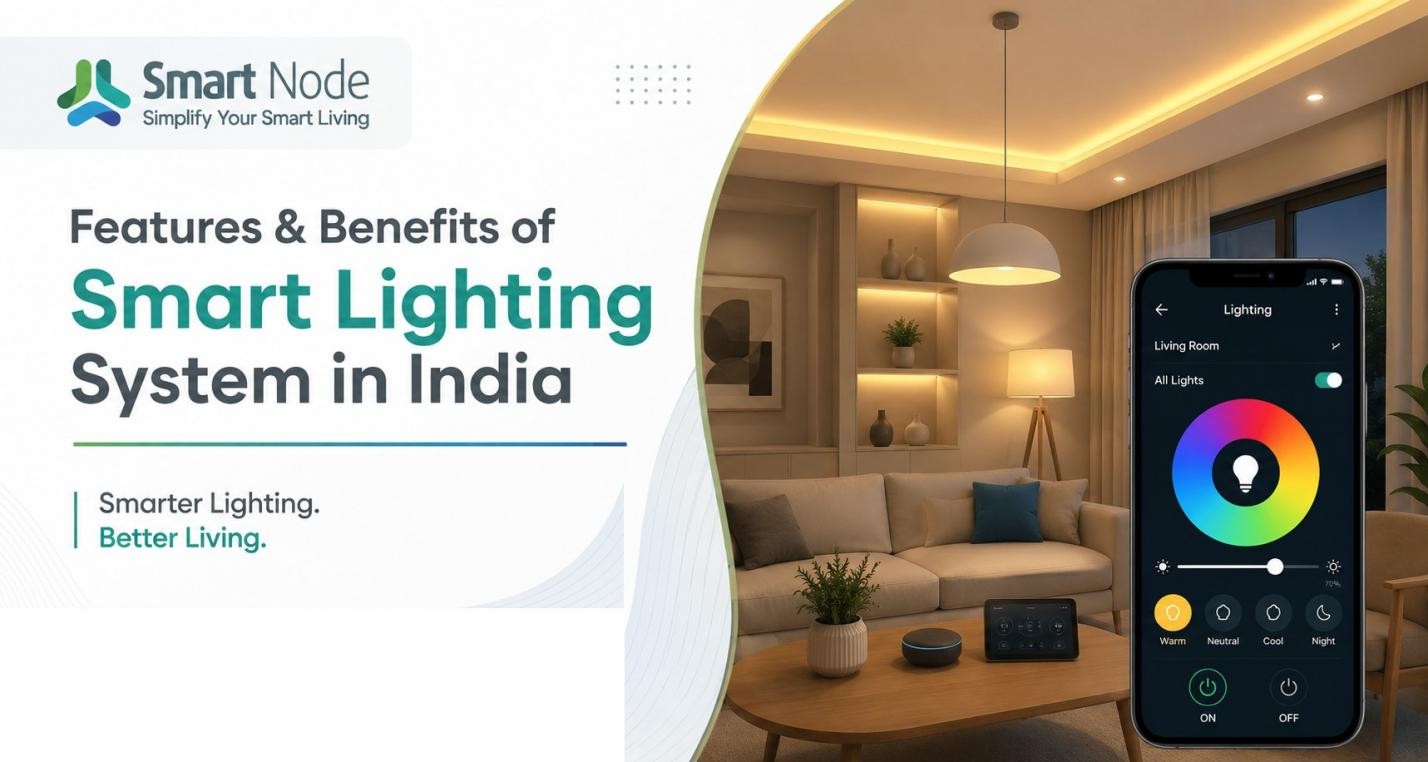
Features & Benefits of Smart Lighting System in India
Most of us have a lighting routine we don’t even think about anymore. Walk into a room, feel for the switch, flip it on. Walk out, forget to flip it off. Get into bed, realise the living room light is still glowing, and either get up again or just let it be.
A smart lighting system changes this basic equation. Instead of manually operating every switch, you get a way to control, schedule and personalise your home’s lighting from your phone, your voice, or a wall panel that responds to a tap.
Smart lighting in India has moved well beyond early adopters. Apartments, villas, offices and even small retail spaces are now being designed or retrofitted with some form of lighting automation. Whether you’re building a new home, renovating an old one, or simply tired of walking across the house to switch off a light, it’s worth understanding what a smart lighting system actually does and what it doesn’t.
What Is a Smart Lighting System?
A smart lighting system connects your lights to a network of switches, controllers, sensors, and an app, so that you can decide when, where and how your lights operate instead of relying purely on manual switching.
The difference between conventional lighting and smart lighting comes down to one thing: intelligence. A traditional light only knows two states—on and off, controlled by a physical switch. A smart light, on the other hand, can be scheduled, dimmed, grouped with other lights, and triggered by conditions like time of day or a voice command.
It’s worth clearing up a common misconception here. A smart bulb by itself is not the same as a smart lighting system. A single smart bulb gives you app control over one light. A proper lighting automation setup ties multiple lights, switches and rooms together, so your home behaves as one connected system rather than a set of individually controlled gadgets.
How Smart Lighting Works
The basic flow behind most smart lighting systems looks like this:
You (switch, app, voice) → Smart controller → Light
You can typically control lighting through:
- A physical smart switch or touch panel on the wall
- A smartphone application
- Voice commands through Google Home or Alexa
- Sensors that detect motion or occupancy
- Pre-set automation scenes
- Timers and schedules
One point that homeowners often overlook is how the system communicates internally. Some setups depend entirely on an active internet connection to function, which means a Wi-Fi outage can leave you without basic control. Others operate over your local Wi-Fi network itself, so lights, fans and switches keep responding as long as your router is powered on—internet or no internet. This distinction matters more than most buyers realise, and it’s worth asking about directly before you commit to a system.
Types of Smart Lighting Systems Available in India
There isn’t a single “correct” way to do smart lighting. The right choice depends on your home, your existing wiring, and how much automation you actually want.
- Smart bulbs: Easiest entry point, no rewiring, but limited to individual lights and usually work independently of your wall switches.
- Smart switches: Replace or sit behind your existing switches, letting you keep the familiar wall-switch experience while adding app and voice control.
- Smart dimmers: Add brightness control to lights that were previously just on/off.
- Sensor-based lighting: Lights that respond to motion or occupancy, useful for passages, staircases and bathrooms.
- Complete lighting automation systems: A backend device manages multiple loads (lights, fans, curtains) per switchboard, controlled centrally through app, touch panel or voice.
- Integrated smart-home lighting systems: Lighting automation combined with curtains, security, climate and entertainment as one connected experience.
For most Indian homes undergoing a proper renovation or fresh build, a complete automation system tends to make more sense than scattering individual smart bulbs room by room.
Key Features of Smart Lighting Systems
Smart lighting isn’t just about switching lights on and off remotely. Its real value comes from the combination of control, automation and personalisation working together.
Voice and App-Based Control
You’re already in bed and realise the living room lights are still on. Instead of getting up, you switch them off from your phone, or simply say a voice command if your setup supports it.
This kind of control extends beyond convenience at home. Depending on the system, you may be able to check on your lights while at work, or turn on the porch light before you reach home in the evening as long as your phone and home network both have internet access at that moment.
Dimming and Colour Temperature Adjustment
Lighting needs change through the day, and a smart lighting system lets you adjust for that. Bright, cool-toned light works well for a home office or kitchen during work hours. Warmer, dimmer lighting feels more appropriate for a living room in the evening or a bedroom at night.
This is where dimmable and tunable lighting genuinely earns its place. Rather than every room running at the same fixed brightness all day, you can shift lighting to suit relaxing, working, entertaining or winding down for sleep without swapping fixtures or bulbs.
Scheduling and Automation Scenes
This is arguably where lighting automation delivers the most everyday value, because it removes repetitive manual actions from your routine.
A few common examples:
- Morning scene: Lights gradually come on at a comfortable brightness instead of a harsh, sudden switch-on.
- Movie scene: Main lights dim while a soft ambient light stays on in the background.
- Night scene: All lights step down to a low, comfortable brightness before bed.
- Away scene: Selected lights and appliances switch off automatically once everyone has left.
Instead of remembering to individually adjust five or six switches every time your routine changes, a scene does it in one action.
Integration with Smart Home Ecosystems
Lighting rarely operates in isolation in a well-planned smart home. It typically works alongside:
- Curtains and blinds
- Security devices like door locks and gates
- Motion and occupancy sensors
- Entertainment systems
- Climate control (AC on/off)
A well-designed lighting automation setup should feel like one connected experience rather than a collection of unrelated smart gadgets that each need their own app.
Top Benefits of Smart Lighting for Indian Homes and Offices
Features are one thing—what actually changes in day-to-day life is another. Here’s what a properly configured system tends to deliver.
Energy Savings and Lower Electricity Bills
Smart lighting can help reduce unnecessary electricity consumption through scheduling, occupancy-based automation, timers and centralised control that make it easier to avoid lights being left on when nobody’s in the room.
That said, it’s worth being realistic here. The actual savings you see depend on several factors—how many lights you have, their wattage, your household’s usage patterns, how the automation is configured, and how consistently it’s used. No two homes will see identical results, so treat energy efficiency as a genuine benefit rather than a guaranteed number.
Enhanced Comfort and Ambience at Home
Good lighting shapes how a space feels, not just how visible it is. Warmer tones in the evening, brighter light for focused work, soft lighting for a child’s bedtime, or a slightly dimmed dining area for guests—these small adjustments add up to a home that feels considered rather than just lit.
This applies just as much to a puja space that benefits from a warm, calm glow, as it does to a work-from-home setup that needs brighter, cooler light through the day.
Improved Security with Smart Light Automation
Automated lighting can make a home appear occupied even when it isn’t—lights following a schedule, an “away” scene activating when everyone leaves, or lighting tied into your broader home lighting system and security setup.
It’s important to be clear-eyed about this, though: lighting automation is a useful layer of deterrence, not a complete security solution on its own. It works best alongside proper locks, monitoring and access control, not as a replacement for them.
How to Choose the Right Smart Lighting System in India
This is the part that actually determines whether your investment feels worthwhile a year later.
Budget vs. Premium Smart Lighting: What to Consider
- Entry-level solutions: Individual smart bulbs, basic smart plugs, single-device control. Good for testing the waters or a rented apartment where rewiring isn’t an option.
- Mid-range solutions: Smart switches , dimmers, control across multiple rooms, and a handful of basic scenes.
- Premium systems: Home automation solutions with integrated lighting, centralised control, multi-device scenes, professional installation and room for future expansion.
Price alone shouldn’t decide this. It’s worth weighing reliability, ease of installation, scalability, warranty coverage, ongoing support, compatibility with other devices, and how much genuine automation you’ll actually use, not just what looks impressive in a showroom demo.
Compatibility with Existing Wiring and Switches
This matters more in Indian homes than buyers often expect, because wiring standards and switchboard configurations vary quite a bit between older and newer construction.
Before choosing a system, it helps to check:
- Your existing electrical wiring and switchboard layout
- Whether a neutral wire is available where required
- Load compatibility with your current fixtures
- Whether the system is designed for retrofitting or needs fresh wiring
- Electrical safety requirements
Not every home has identical wiring, so don’t assume a system that worked for a friend’s flat will drop in seamlessly at yours. A proper on-site or professional assessment is the safest way to plan an automated lighting system that actually fits your home, rather than working around it.
Bringing It All Together
Smart lighting isn’t really about controlling a bulb from your phone—that’s just the surface layer. The real value is in building a home lighting system that responds to how you and your family actually live: dimmer in the evenings, brighter for work, automated when you’re away, and simple enough that guests don’t need an instruction manual to use it.
The right setup for your home depends on your layout, your existing wiring, your daily routine, your budget, and how much room you want to leave for expanding the system later.
If you’re planning lighting automation for a new home, a renovation, or an existing property that needs a practical retrofit, it’s worth exploring how SmartNode’s home automation solutions are designed around real Indian homes, so you can build a lighting experience that’s genuinely easier to live with, not just technically impressive.
Frequently Asked Questions
There’s no single fixed price, because cost depends on the number of lights and switches involved, whether you choose smart bulbs or a complete switch-based system, how many automation scenes and sensors you want, installation requirements, and the size of your property. A single room with a few smart switches will cost far less than home automation with integrated curtains, security and climate control. It’s best to get a requirement-based quote rather than going by a generic figure you’ve seen online.
There isn’t one universal best system; it depends on your home and priorities. What you should look for is a system that’s reliable, compatible with your home’s existing electrical setup, scalable as your needs grow, easy to control day to day, capable of genuine automation (not just remote on/off), and backed by local installation and after-sales support. Brands like Smart Node are built specifically around retrofit-friendly installation and Indian home wiring, which is worth factoring in during comparison.
It depends on the system. Some smart lighting products rely entirely on an active internet connection to function, so an outage limits control. Others operate over your local Wi-Fi network, meaning your lights, switches and scenes keep working as long as your router has power even without internet. A few setups also retain basic manual switch functionality regardless of connectivity. Always confirm this distinction with the manufacturer rather than assuming all smart systems behave the same way.
Many smart lighting products sold in India are designed to work with the standard 230V supply, but compatibility should always be verified against the specific product’s electrical rating rather than assumed. Check the rated voltage, load capacity, wiring requirements and relevant safety certifications before installation, and have the setup done by a qualified electrician or the brand’s own installation team rather than attempting DIY wiring changes.
Related Blogs
09 Oct, 2026
Blog
Smart Remote Control Systems for Home Automation
A modern living room can have a surprising number of remotes. One for…
09 Oct, 2026
Blog
Smart Power & Socket Automation Guide
A socket is easy to ignore until you start thinking about everything connected…
09 Oct, 2026
Blog
Office Automation Systems: A Practical Guide to Building Smarter Workspaces
An office usually reveals how it is managed within the first few minutes.…