Published on 09 Sep, 2026 | Updated on 13 Oct, 2026 | By SmartNode ⏱️ 12 min read
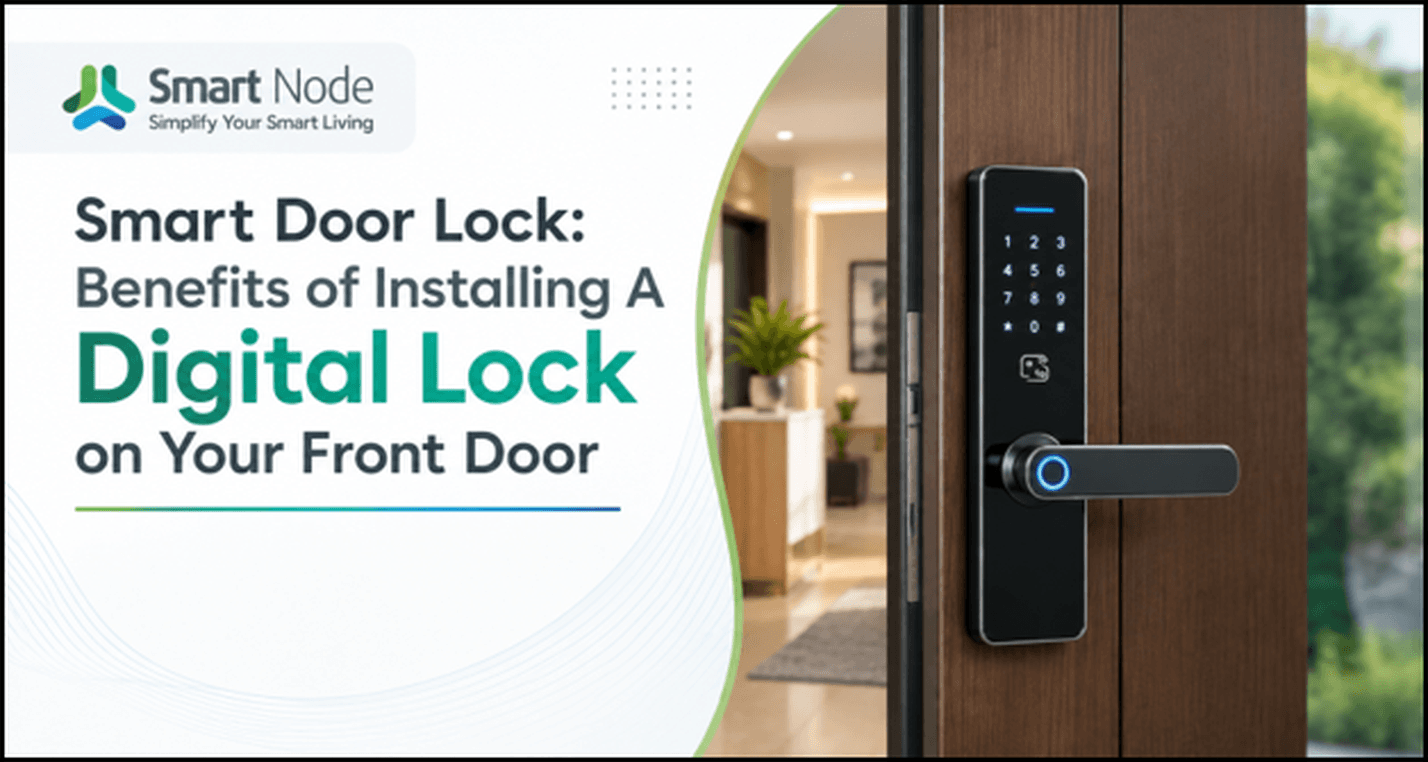
Smart Door Lock: Benefits of Installing A Digital Lock on Your Front Door
Fumbling for keys outside your own front door, at night, with your hands full of grocery bags, is a small but familiar frustration. So is the anxiety of wondering whether you actually locked up before leaving for a two-week trip.
A smart door lock system solves both problems by replacing (or working alongside) your traditional key-and-latch mechanism with fingerprint, PIN, card or app-based access. It’s no longer a niche gadget either — smart locks are increasingly common in Indian apartments, independent villas, rented flats and offices, largely because they solve a very ordinary, everyday problem: managing access without depending entirely on a physical key.
This guide walks through how a digital lock actually works, what to look for before buying one, and what installation realistically involves for an Indian home.
What is a smart door lock and how does it work?
A smart door lock is an electronic locking device that replaces or upgrades your traditional mechanical lock, allowing you to lock and unlock your door using methods other than a physical key such as a fingerprint, a PIN code, an RFID card, or a smartphone app.
At its core, the lock still performs the same mechanical job any lock does: it secures the door. What changes is how it’s triggered. Instead of a metal key turning a cylinder, an internal motor or bolt mechanism responds to a verified input, your fingerprint matching a stored record, a correct PIN being entered, or a command sent from your phone over Wi-Fi or Bluetooth.
Most digital locks also include layers that a traditional lock simply can’t offer: an anti-theft alarm if someone tampers with it, automatic lockout after repeated wrong attempts, and a low-battery alert so you’re never caught off guard. Wi-Fi-enabled locks go a step further, sending real-time notifications to your phone and allowing remote access management useful if you want to let someone in while you’re not home.
Types of smart door locks available in India
Smart locks in India broadly fall into a few categories, and the right one depends on how you plan to use it:
- Non-Wi-Fi (offline) digital locks: Controlled through fingerprint, PIN, RFID card or mechanical key override, without app-based remote access. A practical, budget-friendly option for anyone who wants keyless convenience without needing to manage things remotely.
- Wi-Fi-enabled smart locks: Add remote access, real-time activity notifications and multi-user management on top of the offline features, letting you monitor and control the lock from your phone from anywhere.
- High-security Wi-Fi locks: Positioned for homeowners who want the fullest feature set deeper access control, integration with a broader smart home ecosystem, and stronger security layers.
- Door lock controllers: Rather than being a lock themselves, these are devices that connect to an existing EM lock or NO/NC-based digital lock and bring it into an app-controlled ecosystem. This is a useful route for offices or homes that already have an electromagnetic lock installed and don’t want to replace the hardware.
There’s no single “correct” choice here; a family that mostly wants to stop carrying keys will be well served by an offline model, while a household that wants remote monitoring, temporary guest access or automation scenes will benefit more from a Wi-Fi-enabled one.
Top benefits of installing a smart door lock on your front door
Keyless entry: no more lost or duplicate keys
The most immediate benefit of smart locks for home setup is simply not carrying a physical key anymore. No spare key hidden under the doormat, no last-minute duplicate cut for a new house help, and no re-keying the entire lock because someone lost a copy.
Most digital locks support multiple ways to get in without a physical key, a registered fingerprint, a PIN entered on a keypad, or an RFID card tapped against the lock. Between fingerprint storage, PIN codes and RFID cards, a household can typically register access for every family member without anyone needing to carry anything at all.
Enhanced home security with real-time access logs
Traditional locks don’t tell you anything after the fact you can’t know who entered your home, or when, unless you happened to be there. A smart lock changes that by keeping a record of activity.
Wi-Fi-enabled locks can send real-time notifications to your phone whenever the door is unlocked, so if your children get home from school, or the house help arrives for their shift, you get a notification without having to ask. This is particularly useful for families with elderly parents living alone, or for anyone who travels frequently and wants a way to check in on their home remotely.
Locks with an anti-theft alarm and intrusion lockout after repeated wrong attempts add a further layer of protection against tampering, and a mechanical key override still exists as a backup, so you’re never permanently locked out even if the electronics fail.
Remote access and control via smartphone
This is where a Wi-Fi-enabled smart door lock system genuinely earns the “smart” label. Instead of being physically present to let someone in, you can grant temporary access remotely useful when a delivery is arriving, a guest needs to let themselves in before you’re home, or a maintenance visit is scheduled while you’re at work.
Depending on the lock, this can include single-use access codes that expire after one use, or time-bound passwords that are only valid for a set window, so you’re not handing out permanent access to someone who only needs to enter once. Multi-user access management also means every family member, or every tenant in a rented flat, can have their own credentials rather than sharing one universal code.
Key features to look for in a digital door lock
Biometric fingerprint recognition
Fingerprint access tends to be the fastest and most convenient unlock method day-to-day, since there’s nothing to remember or carry. Most digital locks in this category can store a meaningful number of fingerprints, which matters for larger families or shared households where several people need individual access. It’s worth checking the stated fingerprint capacity of any lock you’re considering, since this varies between models.
Smart home integration: Alexa, Google Home, and Smart Node
A digital lock doesn’t have to function in isolation. Locks that are Wi-Fi enabled and part of a broader smart home ecosystem, like Smart Node, can work alongside voice assistants such as Alexa and Google Home, and can also trigger automation scenes, for example, unlocking the door and having the entryway lights turn on together, instead of needing to operate them separately. This kind of integration is worth prioritising if you’re already using, or planning to use, other smart home devices in your house.
PIN pad, RFID card, and app-based unlock options
Beyond fingerprint access, most digital locks support a combination of PIN codes, RFID cards and app-based unlocking, along with a mechanical key override as a fallback. Having multiple unlock methods matters in practice, a PIN is handy for guests who don’t want to install an app, an RFID card works well for domestic staff, and app-based control is useful when you’re not physically at the door. A good lock gives you the flexibility to use whichever method suits the moment, rather than forcing one single approach on every user.
How to install a smart door lock on your front door
Professional installation vs. DIY: what works in India
While some smart locks are marketed as easy, tool-free installs, front-door locks are a different case from, say, a smart switch; they’re a critical security and safety fixture, and doors, frames and existing lock cutouts vary quite a bit between homes in India. A professional installation is generally the safer route, since it ensures the lock is fitted correctly, the door alignment is checked, and the electronics are set up and paired properly from day one.
If you’re working with a home automation provider for your broader setup, it’s often worth having the same team handle the door lock installation, so it’s configured correctly as part of your overall system rather than as a standalone add-on.
Is your existing door compatible with a smart lock?
Not every door is an automatic fit for every digital lock, and this is a step worth getting right before you buy. A few things to check:
- Door material: Wooden doors, metal doors and glass doors each have different mounting and drilling requirements.
- Door thickness: Most locks are designed for a specific thickness range, so it’s worth confirming this against your door before ordering.
- Existing cutout: If you’re replacing an older mortise lock, the existing cutout size may or may not match the new lock’s requirements.
- Door frame condition: A door that doesn’t close and align well on its own can cause issues with any electronic lock, regardless of brand
A brief on-site assessment, either from the lock provider or a qualified installer, is the most reliable way to confirm compatibility rather than assuming it based on general specifications alone.
Smart door lock for homes, flats, and offices in India
The use case for a smart lock shifts a little depending on where it’s installed. For independent homes and villas, the priority is usually strong front-door security combined with convenience for family members. In apartments and flats, space constraints and society-approved installation guidelines can matter as much as the lock’s features. For offices, multi-user access management and activity logs become more important than biometric convenience alone, since the priority is knowing who accessed the space and when, particularly outside working hours.
A door controller is also worth considering for spaces that already have an EM lock or an existing digital lock installed rather than replacing the hardware, it brings that existing lock into an app-controlled system, which can be a more cost-effective route for offices or common areas that already have compliant locking hardware in place.
Final Thoughts
A smart door lock isn’t just about ditching your keys, it’s about having clearer visibility and control over who enters your home, and when, without adding complexity to your daily routine. The right choice depends on whether you need offline convenience or full remote access, how many people need individual entry credentials, and whether you want it to work as part of a larger smart home setup.
If you’re considering a digital lock for a new home, an existing front door, or an office space, it’s worth exploring how Smart Node’s Bolt series of smart locks and door lock controllers are built to work within a connected home automation ecosystem, so your front door becomes part of a genuinely smarter home, not just a standalone gadget.
Frequently Asked Questions
1. What is smart door lock system in India?
A smart door lock system in India refers to an electronic locking device that replaces or upgrades a traditional key-based lock, allowing access through fingerprint, PIN, RFID card or a smartphone app. Depending on the model, it may work purely offline through these local methods, or connect to Wi-Fi for remote access, real-time notifications and multi-user management. Most systems also retain a mechanical key override as a backup, so a dead battery or electronic fault doesn’t permanently lock you out.
2. What is the price of a smart door lock in India?
Pricing varies depending on the type of lock — offline models with fingerprint, PIN and RFID access are generally priced lower than Wi-Fi-enabled locks with remote access and smart home integration, and high-security variants with a fuller feature set sit at the premium end. Installation, door compatibility work, and any additional accessories can also affect the final cost. It’s best to get a quote based on your specific door and requirements rather than relying on a generic figure.
3. Can a smart door lock be hacked?
No connected device is entirely immune to attempted tampering, which is why reputable smart locks build in multiple safeguards — scrambled password protection so PINs can’t be easily guessed, automatic intrusion lockout after repeated wrong attempts, and an anti-theft alarm if the lock is tampered with physically. Choosing a lock from an established manufacturer, keeping its firmware updated where applicable, and using strong, unique PINs meaningfully reduces risk. As with any security device, no lock can claim to be completely unhackable.
4. What happens when the battery of a smart lock dies?
Most digital locks issue a low-battery alert well before the battery actually runs out, giving you time to replace or recharge it. If the battery does die unexpectedly, locks typically include a mechanical key override or a USB-C emergency power port that lets you supply temporary external power to unlock the door and change the batteries. This is a standard safety feature across most reputable smart locks, precisely so you’re never permanently locked out.
5. Are smart door locks suitable for Indian wooden and metal doors?
Smart locks are generally designed to work with both wooden and metal doors, but suitability depends on the specific door’s thickness, existing cutout size and frame condition, not just the material itself. It’s advisable to have your door assessed before installation, either by the lock manufacturer or a qualified installer, to confirm it matches the lock’s mounting and thickness requirements. Glass doors and certain non-standard door types may need a different approach altogether, so it’s worth checking this upfront rather than assuming universal compatibility.
Related Blogs
17 Oct, 2026
Blog
Upgrade Your Home This Diwali with Smart Home Devices
Diwali changes the way a home is used. The living room stays active…
16 Oct, 2026
Blog
Smart Door Lock & Security Systems Guide
A door lock has one job: control who gets through the door. For…
15 Oct, 2026
Blog
Complete Guide About RGBW Controllers: Types & Features
Colour-changing lighting can completely alter the character of a space. The same room…