Published on 16 Oct, 2026 | Updated on 13 Oct, 2026 | By SmartNode ⏱️ 9 min read
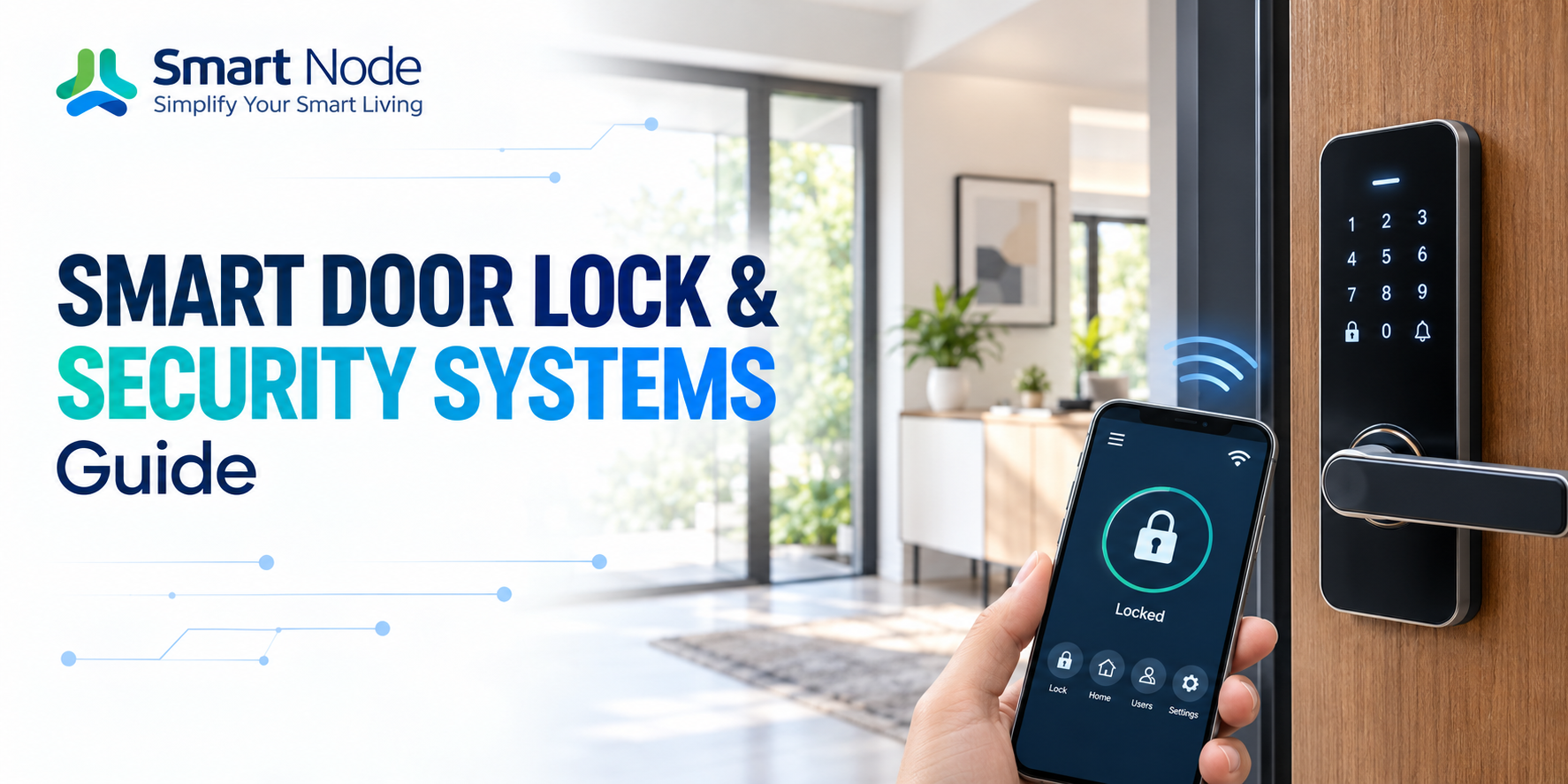
Smart Door Lock & Security Systems Guide
A door lock has one job: control who gets through the door.
For decades, that meant carrying a physical key.
Today, there are more practical ways to manage access. A smart door lock system can replace or complement traditional keys with digital methods such as PINs, supported mobile access and other authentication options.
But the real change isn’t simply getting rid of keys.
It is gaining more control over who can enter, how they enter and how access is managed over time.
For a home, this can make everyday entry more convenient. For villas, offices and other properties with multiple users, the benefits can extend to access management and security routines.
What Is a Smart Door Lock System?
A smart door lock system is an electronically controlled locking system that allows a door to be locked or unlocked using supported digital access methods rather than relying solely on a conventional mechanical key.
Depending on the lock, these methods can include a PIN or keypad doorlock interface, mobile access and other authentication technologies.
Traditional locks generally answer one question:
Do you have the key?
A smart lock can provide a more flexible access model.
A family member may have their own access method. Temporary access can be provided where supported. Access can also be managed without physically handing someone a spare key.
This becomes particularly useful in homes where different people need access at different times.
A smart lock can also become part of a broader smart security system, working alongside other connected security and automation functions.
How Smart Locks Differ from Traditional Locks
A traditional lock is largely mechanical.
A smart lock combines the physical locking mechanism with electronic access control.
The door still needs a properly designed locking mechanism and suitable installation. The difference is in how access is authorised.
Instead of searching for keys, a user can use the authentication method supported by the lock.
That doesn’t make the mechanical side irrelevant. A smart lock still needs to be correctly installed, powered and maintained.
The best digital experience is of little value if the underlying door hardware is unsuitable.
Types of Smart Door Locks
Not every smart lock uses the same access method.
Keypad Door Locks
A keypad doorlock uses a PIN or passcode for access.
This is useful for households where multiple people need entry without sharing physical keys.
It can also be practical when access needs to be given to selected users without issuing additional keys.
The exact access-management features depend on the lock.
App-Based Smart Locks
App-connected locks can allow supported users to manage access through a mobile application.
Depending on the system, users may be able to check lock status or control access remotely.
This can be particularly useful when homeowners are away and need to manage entry for someone else.
Multi-Method Smart Locks
Some smart locks combine several access methods.
This provides flexibility for different members of the household or different situations.
For example, one user may prefer a keypad while another uses a supported mobile method.
The advantage is having more than one way to authenticate without depending entirely on a physical key.
How Does a Smart Door Lock Work?
The basic process is simple.
A user presents an approved credential.
The lock verifies it.
If the credential is authorised, the electronic locking mechanism responds.
The exact authentication process depends on the product.
In a keypad-based system, the user enters the configured code.
In an app-based system, the command may come through the supported mobile platform.
Behind that interaction is the physical lock mechanism, power supply and electronic control system.
This is why choosing a smart lock isn’t simply about looking at the number of digital features.
The lock needs to be compatible with the door, suitable for the intended use and installed correctly.
Smart Locks for Home: Where They Make Sense
The biggest advantage of smart locks for home is often convenience.
Think about arriving home with shopping bags.
A traditional key requires one hand to find the key, insert it and unlock the door.
A supported digital access method can make entry simpler.
There are other everyday situations too.
Children can use their assigned access method.
Family members don’t necessarily need to share one physical key.
A trusted person can potentially be given access without creating another copy of the key, depending on the system.
And when you leave home, you don’t have to wonder whether you remembered to lock the door if the system provides a way to check or manage its status.
Smart Door Locks and Home Security
A smart lock is one component of security—not the entire security system.
A complete smart security system may include access control alongside other security technologies and automation features.
The value of integrating these functions is that they can work together.
For example, an arrival scene could respond to authorised entry by activating selected home functions.
A departure routine could turn off selected devices and place the home into an appropriate security state.
The exact capabilities depend on the automation platform and connected devices.
The important distinction is that a smart lock controls access, while a wider security system addresses the broader security environment.
Managing Access Without Physical Keys
One of the most useful changes introduced by digital locks is the ability to rethink how access is distributed.
With a conventional lock, giving someone access usually means giving them a physical key.
That creates an obvious problem when the key is lost, copied or no longer needed.
Digital access can provide more flexibility.
A household may have several regular users.
A service provider may need access at certain times.
A guest may need temporary entry.
Where the lock supports it, access can be configured according to the requirements of the system.
This makes access management particularly relevant for larger homes and properties with multiple occupants.
What to Look for in a Smart Door Lock
A smart lock should be evaluated as a security product first and a connected gadget second.
Lock Compatibility
The lock needs to work with the actual door construction, dimensions and existing hardware.
Access Methods
Consider which authentication methods the household will realistically use.
A keypad doorlock may be ideal for one family, while another may prefer mobile access or multiple methods.
Power and Backup
Electronic locks require power. Understand how the lock is powered and what happens if the primary power source becomes unavailable.
A suitable backup or emergency access mechanism can be an important consideration.
Physical Security
Digital features don’t replace strong physical hardware.
The lock body, cylinder or locking mechanism, door frame and installation quality all contribute to the overall security of the door.
Integration
If the lock is going into a smart home, check whether it can work with the wider automation ecosystem.
A connected lock is more useful when it can participate in the routines you actually want to create.
Smart Door Lock vs. Traditional Door Lock
The difference is primarily about access management.
A traditional lock is straightforward and familiar. A smart lock adds electronic authentication and potentially connected control.
That can provide more flexibility, but it also introduces additional considerations such as power, electronics, software and connectivity.
For someone who simply wants a conventional mechanical locking solution, those additional features may not be necessary.
For households that want keyless access and integration with a wider automation system, a smart lock can provide a different level of control.
Installing Smart Locks in Existing Homes
Smart locks aren’t limited to new construction.
Many homeowners consider them during renovations or as standalone security upgrades.
The important step is checking compatibility before installation.
Door thickness, lock dimensions, existing hardware, frame alignment and power requirements can all affect installation.
A retrofit installation should therefore begin with the door—not the product catalogue.
Once compatibility is established, the lock can become part of a broader home automation plan.
Smart Locks as Part of a Larger Automation System
The most interesting possibilities appear when access control connects with other parts of the home.
An authorised entry could trigger selected lighting.
A departure routine could switch off selected devices.
A security-related scene could place the property into a predefined state.
These interactions depend on the automation platform and the devices involved, but the underlying idea is straightforward:
The door doesn’t have to operate in isolation.
It can become the trigger for what happens next.
That is where a smart door lock system becomes more than a replacement for a key. It becomes one of the control points through which the home responds to the people using it.
Frequently Asked Questions
1. Are smart locks for home safe?
Smart locks can provide secure digital access when the lock is appropriately designed, correctly installed and properly maintained. Security depends on both the electronic system and the physical locking hardware.
2. What is a keypad doorlock?
A keypad doorlock allows authorised users to unlock the door by entering a configured PIN or access code instead of using a conventional physical key.
3. Can smart door locks work during a power failure?
This depends on the lock’s design and power arrangement. Before choosing a lock, check its battery or backup system and the emergency access method provided by the manufacturer.
4. Can a smart lock be installed on an existing door?
Often, yes. However, compatibility depends on the door construction, dimensions, existing locking hardware and the specific smart lock. A proper installation assessment is recommended before purchase.
5. Can a smart door lock be part of a smart security system?
Yes. Where compatible, a smart lock can be integrated with other automation and security functions, allowing access events to trigger selected actions elsewhere in the property.
Related Blogs
17 Oct, 2026
Blog
Upgrade Your Home This Diwali with Smart Home Devices
Diwali changes the way a home is used. The living room stays active…
15 Oct, 2026
Blog
Complete Guide About RGBW Controllers: Types & Features
Colour-changing lighting can completely alter the character of a space. The same room…
14 Oct, 2026
Blog
Smart Remote Control Systems for Home Automation
A modern living room can have a surprising number of remotes. One for…