Published on 09 Oct, 2026 | Updated on 09 Oct, 2026 | By SmartNode ⏱️ 11 min read
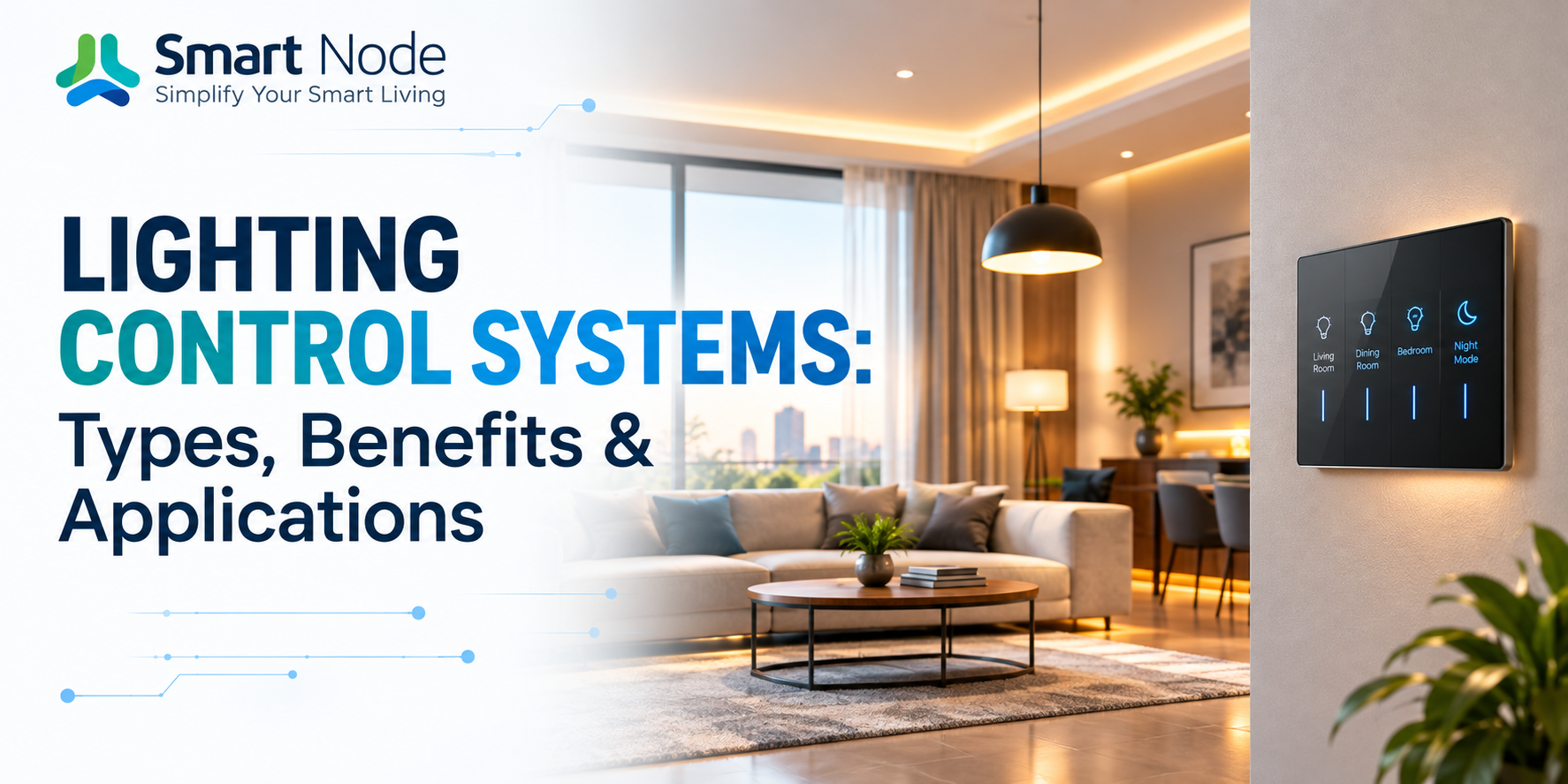
Lighting Control Systems: Types, Benefits & Applications
Lighting is usually planned room by room. A switch is placed near the door, lights are divided into a few circuits, and the electrical work is finished. That works perfectly well until the lighting requirements become more demanding.
A large villa might have dozens of lighting circuits. An office may have separate requirements for cabins, workstations, meeting rooms and common areas. A hotel, showroom or restaurant may need lighting to change throughout the day. At that point, putting more switches on the wall isn’t really a solution.
A lighting control system gives the installation another layer: the ability to operate different lights, groups and scenes in a coordinated way. Depending on the technology used, it can provide switching, dimming, scheduling, scene control and colour management from dedicated control points or an application. For projects where lighting is part of the architecture, interiors or overall user experience, that additional control can be significant.
What Is a Lighting Control System?
A lighting control system is an arrangement of devices that allows lighting circuits or fixtures to be controlled beyond conventional manual switching.
The simplest example is a dimmer. Instead of choosing between completely on and completely off, the user can set the light somewhere in between. Add multiple dimmers and switches, and those individual controls can be brought together into groups. Add scenes, and several lights can change together.
Imagine a living room with cove lighting, pendant lights, wall lights and accent lighting. A conventional installation may require four separate controls. With a lighting control system, those same lights can be organised into scenes:
- All On for everyday use.
- Entertain with brighter ambient lighting and selected accent lights.
- Evening with the main lights dimmed and decorative lighting retained.
The hardware hasn’t changed what the lights are capable of. The control system changes how easily they can be operated together.
Where DALI Fits In
DALI (Digital Addressable Lighting Interface) is a digital lighting control protocol used for communication between compatible lighting control equipment and luminaires or control gear.
The useful part is the word addressable. With conventional switching, several fixtures may simply belong to one electrical circuit. Digital control can allow compatible fixtures or groups to be addressed individually. That opens up considerably more flexibility when a project has a large number of lights or requires detailed control.
DALI is particularly relevant in commercial lighting projects, offices, hospitality spaces and other installations where lighting needs to be managed at a more granular level.
How Lighting Control Differs from Basic Smart Lighting
A smart bulb controlled from a mobile phone is connected lighting. It isn’t necessarily a complete lighting control system.
The difference becomes apparent when the number of lights increases. Controlling one bedroom light from an app is straightforward. Managing twenty or fifty lighting circuits requires proper grouping, control logic and a sensible interface.
A lighting control system is therefore less about putting every light online and more about organising the lighting into something people can actually operate.
Core Components: Controllers, Dimmers, Gateways and Control Interfaces
There is no single piece of hardware that defines a lighting control installation. The exact combination depends on the project.
- Controllers and switching devices: Handle the electrical commands sent to lighting circuits.
- Dimmers: Regulate the intensity of compatible lighting loads.
- Gateways: Allow different technologies to communicate with one another. A DALI gateway, for instance, can connect DALI lighting equipment to a broader automation environment.
- Control interfaces: What people interact with: keypads, switches, touch panels or mobile applications.
A well-planned system keeps these layers working together without making everyday operation complicated.
Types of Lighting Control Systems
Not every project needs the same architecture. The right lighting control system depends on the building, the electrical installation and the level of control expected.
Standalone Lighting Control
Standalone control is the simplest arrangement. A particular device controls a particular circuit, room or group without requiring the entire property to be connected to one network. This can be appropriate when only a limited number of lighting points need advanced control.
Centralized (Networked) Lighting Control
A centralized system connects several lighting zones to a common control environment. That can be useful in a large residence, office or commercial property where users need to operate lighting across multiple areas without visiting each room individually. It also makes scene management more practical. A single command can affect several zones at once.
Wireless Lighting Control Systems
Wireless control is particularly relevant when automation is being added to a completed property. Rebuilding the electrical infrastructure simply to introduce lighting control isn’t always practical, especially in an occupied office or finished residence.
Retrofit-oriented wireless devices can provide another route by working with existing switchboards and wiring, subject to the electrical configuration and connected load. This is one reason wireless systems have become increasingly relevant to renovation and retrofit projects.
Hybrid Lighting Control Systems
Sometimes there is no reason for an installation to rely on one communication method throughout. A project may use DALI where detailed digital lighting control is required and wireless control elsewhere. A hybrid architecture can therefore make sense when the building contains different types of lighting infrastructure or when automation is being introduced progressively.
How Does a Lighting Control System Work?
The easiest way to understand a lighting control system is to follow what happens when a user presses a button.
The command reaches the relevant control device. The device determines which circuit, group or fixture should respond. The lighting then changes accordingly.
- With a basic switch, the result may simply be ON or OFF.
- With a dimming system, the same command can change brightness.
- With scenes, one command can affect several lights at once.
Take a simple Movie Scene in a home. The main lights can dim, decorative lighting can remain at a lower level and selected accent lights can switch off, all from one command. In a commercial setting, a similar principle can be applied to presentation rooms, boardrooms, reception areas or display spaces.
DALI introduces another level of control because compatible lighting devices can receive digital commands over the DALI network.
Colour adds another dimension. An RGB light controller can be used with compatible RGB lighting to control colour output through the red, green and blue channels. An RGB LED light controller serves the same basic purpose for compatible RGB LED installations. For RGBW lighting, the additional white channel can be controlled alongside the colour channels, giving the lighting designer more options than RGB alone.
The important point is that colour control should be treated as part of the lighting design, rather than simply as a collection of changing colours.
Key Benefits of Lighting Control Systems
The benefits become more apparent when the lighting installation becomes more complex.
Energy Efficiency and Reduced Power Consumption
Leaving every light at full output all the time is rarely necessary. Dimming provides one way to reduce output when full brightness isn’t required. Scheduling can also prevent selected lighting circuits from operating outside their intended hours. Centralized control makes it easier to manage this consistently.
The actual energy reduction will depend on the building and how the lighting is used. A control system does not automatically guarantee a particular percentage of savings. What it does provide is greater control over when and how lighting operates.
Extended Lamp and Fixture Lifespan
A light that doesn’t need to operate doesn’t need to accumulate operating hours. Reducing unnecessary usage can therefore help make better use of the installed lighting equipment.
This matters more as the installation grows. Replacing one fixture in a home is one thing. Maintaining hundreds of fixtures across a commercial property is a very different proposition.
Improved Comfort and Visual Environment
Brightness is not the only consideration. The same room may need different lighting at different times. A dining area may require softer illumination during dinner. A workspace needs enough light for focused tasks. A presentation room may need the front of the room illuminated while the audience area is dimmed.
Scenes and dimming make those changes repeatable. Instead of asking someone to adjust several lights every time the room’s purpose changes, the required settings can be built into the control system. That is where smart light solutions become useful: they allow lighting to follow the way a space is being used.
Centralized vs. Decentralized Lighting Control: Which Is Right for You?
Centralized and decentralized systems solve the same broad problem in different ways.
With centralized control, several lighting zones are managed through a common architecture. This is useful when a property has a large number of circuits or when there is a need to manage lighting across multiple areas.
Decentralized control keeps more of the control within individual rooms or zones. For a smaller project, that can be perfectly adequate. There is little reason to build an elaborate central architecture when only a handful of rooms need automation.
The calculation changes for a large office, hotel or multi-floor property. Managing every zone independently can become cumbersome. The decision should therefore start with the building rather than the technology.
- How many circuits are there?
- How many areas need independent control?
- Will the system grow?
- Does the project require DALI?
- Are retrofit constraints involved?
Answering those questions usually gives a clearer direction than simply choosing between “centralized” and “decentralized” from a brochure.
How to Choose the Right Lighting Control System?
Start with the lighting itself. Identify the fixture types, circuits, dimming requirements and number of zones. Then look at the existing electrical infrastructure if the project is a retrofit.
The control interface matters too. A technically capable system is of limited value if users find it confusing to operate. For larger projects, consider future expansion and integration with other automation systems.
And don’t overlook support. Lighting control becomes part of the electrical infrastructure, so installation, commissioning, troubleshooting and after-sales service matter just as much as the hardware.
Cost of Lighting Control Systems
There isn’t a meaningful single price for a lighting control system. A small installation with a few switches and dimming channels is fundamentally different from a DALI-based commercial project with extensive zoning and centralized management.
Cost can be affected by the number of circuits, type of fixtures, dimming requirements, controllers, gateways, keypads, touch panels and installation work. Retrofit projects also have a different cost equation from new construction.
The useful comparison is therefore the complete installed system and what it delivers, rather than the price of one controller or one switch.
Ready to plan a lighting control system tailored to your space? Explore our smart lighting automation solutions or get in touch with our team to design the ideal setup.
Frequently Asked Questions
1. What is the difference between lighting control and smart lighting?
Smart lighting usually refers to connected lights that can be controlled digitally. A lighting control system goes further by coordinating multiple lights, circuits, dimming functions, scenes and zones through a structured control setup.
2. Are lighting control systems only for commercial buildings?
No. They can be used in residences, villas, offices, hotels, retail stores, restaurants and other spaces. The system architecture simply changes according to the size and requirements of the project.
3. Can lighting control systems be retrofitted into existing buildings?
Yes. Retrofit-friendly solutions can often be integrated with existing switchboards and electrical infrastructure. The exact approach depends on the wiring, connected loads and type of lighting being controlled.
4. How much energy can a lighting control system save?
There is no fixed figure that applies to every installation. Savings depend on the lighting load, operating hours and control strategy. Dimming, scheduling and better centralized control can reduce unnecessary lighting consumption.
Related Blogs
09 Oct, 2026
Blog
Smart Remote Control Systems for Home Automation
A modern living room can have a surprising number of remotes. One for…
09 Oct, 2026
Blog
Smart Power & Socket Automation Guide
A socket is easy to ignore until you start thinking about everything connected…
09 Oct, 2026
Blog
Office Automation Systems: A Practical Guide to Building Smarter Workspaces
An office usually reveals how it is managed within the first few minutes.…